


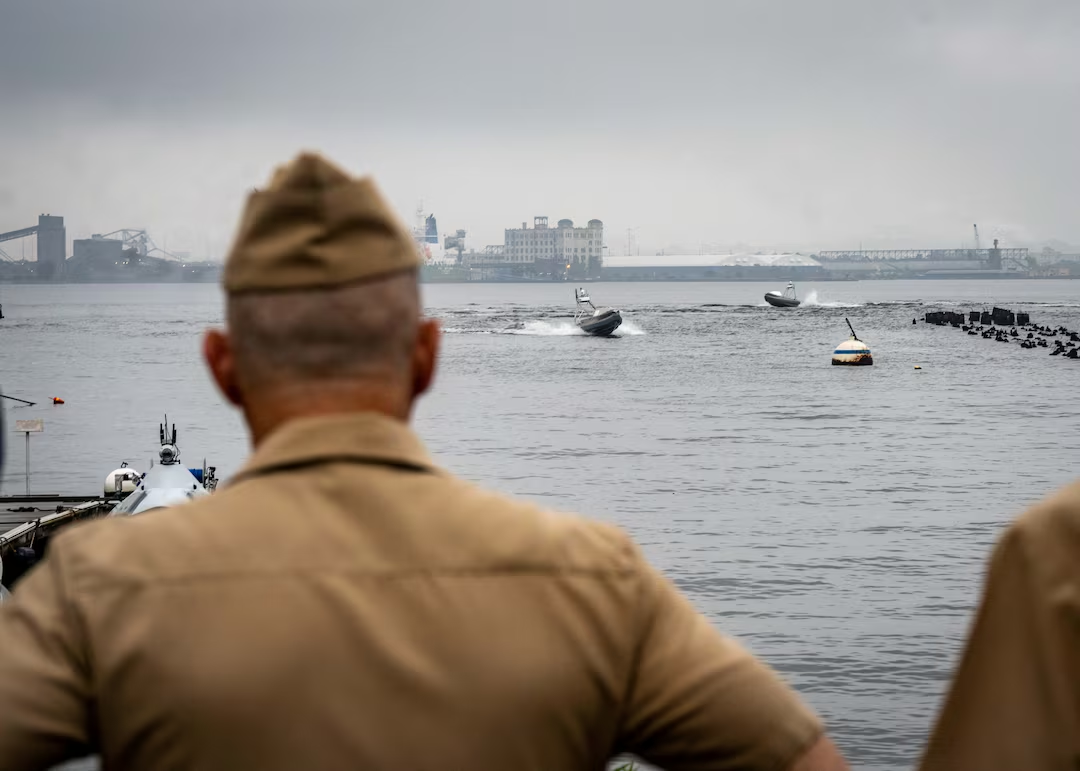
The United States Navy’s ambitious plan to build a fleet of autonomous drone vessels to counter China is facing mounting challenges, after a series of test failures, software problems and leadership turmoil.
During a test off the California coast last month, designed to showcase the Pentagon’s most advanced drone boats, one vessel suffered a software glitch and stalled. As officials scrambled to fix the problem, another autonomous vessel collided with it, smashing into the starboard side before vaulting over the deck and plunging back into the water. The incident, captured on video and obtained by Reuters, involved boats produced by defence tech rivals Saronic and BlackSea Technologies.
Weeks earlier, another mishap occurred when an autonomous BlackSea vessel it was towing suddenly accelerated, capsizing a support craft and throwing its captain into the sea. He was rescued and declined medical attention.
Both accidents were attributed to a mix of software failures and human error, according to a source with direct knowledge of the programme. Neither the Navy, Saronic, nor BlackSea commented on the incidents.
Strategic Stakes
US military leaders have repeatedly pointed to the success of maritime drones in Ukraine, where inexpensive, remote-controlled boats costing around $250,000 have inflicted heavy damage on Russia’s Black Sea Fleet. By contrast, the US Navy’s vision is more ambitious: autonomous fleets capable of operating in swarms without direct human control, with each vessel costing several million dollars.
The Pentagon launched its $1 billion “Replicator” programme in 2023 to accelerate development, with the Navy already committing at least $160 million to BlackSea’s Global Autonomous Reconnaissance Craft. Rival Saronic, recently valued at $4 billion, has also received contracts for prototypes.
However, the test failures highlight the technical and tactical hurdles facing the project. Bryan Clark, an autonomous warfare expert at the Hudson Institute, said the Navy would need to adjust its approach: “It has to adapt its tactics as it better understands what the systems can do and what they can’t do.”
Leadership and Procurement Challenges
The Navy’s autonomous vessel programme has also been hit by internal upheaval. Rear Admiral Kevin Smith, head of the procurement office responsible for unmanned systems, was sacked earlier this year after investigators upheld a complaint against him. The office, known as Program Executive Office Unmanned and Small Combatants (PEO USC), has since been placed under review and could face restructuring or closure.
In addition, the Pentagon’s Defence Innovation Unit recently paused a $20 million contract with L3Harris, a software supplier for the drone boats, following the most recent accident.
Despite the setbacks, senior Navy officials insist autonomous systems will play a central role in future maritime warfare by extending fleet reach and improving combat effectiveness. Acting Chief of Naval Operations Jim Kilby said during a recent visit to a BlackSea facility: “These systems will play a critical role in the future of naval warfare.”
President Donald Trump, who returned to office this year, has made drones a defence priority, with his “Big Beautiful Bill” allocating nearly $5 billion for maritime autonomous systems. Yet scepticism remains within the Pentagon, where officials have raised questions about the pace, cost-effectiveness and viability of the Navy’s drone projects.
As defence analyst T.X. Hammes noted: “You’ve got a system that’s used to building big things, taking years to make a decision, and now suddenly you’re asking them to move fast.”