


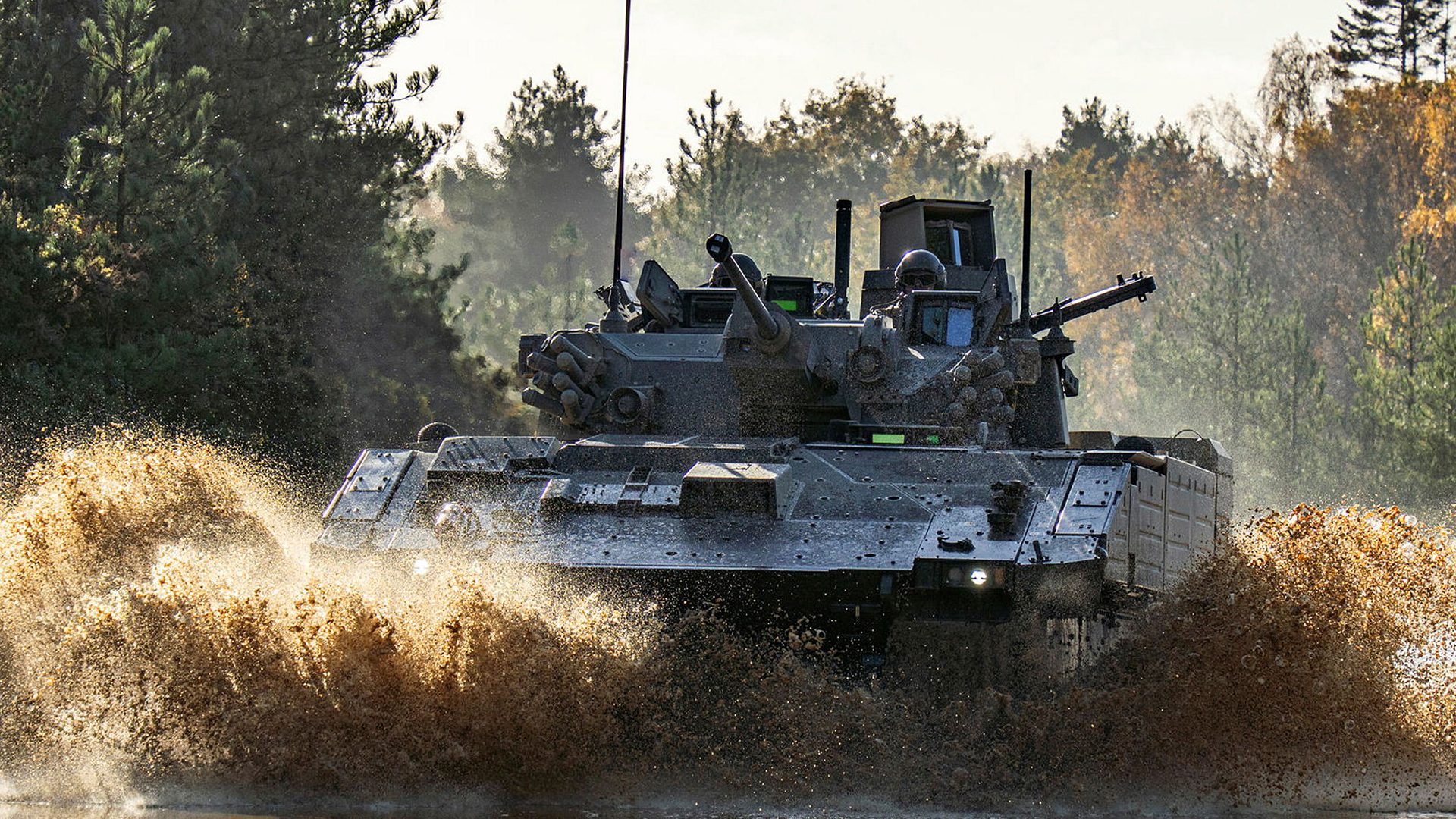
Britain’s long-delayed Ajax armoured vehicle programme is now directly holding up major defence spending decisions, after the Ministry of Defence confirmed that unresolved safety investigations will shape the forthcoming Defence Investment Plan.
In a written statement to Parliament ahead of the Christmas recess, Defence Minister Luke Pollard acknowledged that uncertainty surrounding Ajax has contributed to recent delays in publishing the investment plan, as ministers await clarity on the troubled Army programme.
Multiple investigations remain under way following reports of noise and vibration-related injuries among soldiers operating the vehicles. Pollard said the findings will now feed straight into decisions about future funding and military capability.
“Findings from the investigations into Ajax will be closely aligned to decisions in the Defence Investment Plan,” he told MPs.
The statement is the clearest signal yet that problems with Ajax, intended to form the backbone of the Army’s Armoured Cavalry Programme, are influencing wider defence planning. Pollard confirmed that the use of Ajax for training and exercises was paused on 26 November after around 30 soldiers reported symptoms during Exercise TITAN STORM.
Those personnel had been operating 23 vehicles, all of which have since undergone a detailed 45-point inspection. Of those, 13 have received additional checks focused specifically on potential noise and vibration issues, while inspections on the remaining 10 vehicles are still to be completed. Ministers are expected to receive the results in the New Year.
Alongside the Army’s own inquiry, the Defence Accident Investigation Branch has launched a formal investigation, and a separate ministerial review is also under way. Pollard said the ministerial review is expected to report shortly, while work continues to establish an independent external expert group to provide additional scrutiny.
Although training and exercising were halted immediately, Reliability Growth Trials continued at Bovington to gather baseline safety data. However, Pollard revealed that on 12 December another soldier reported vibration symptoms during those trials.
“This additional report of an injury is a serious concern to me,” he said.
The soldier did not require hospital treatment and is receiving medical support, but the vehicle involved was immediately withdrawn from service. Pollard stressed it was not one of the vehicles used during Exercise TITAN STORM, but part of the trials designed to establish comparative safety data.
In response, the defence minister ordered a further escalation.
“Out of an abundance of caution, and to ensure the safety of our personnel, I have directed a pause on all Ajax trials,” he said.
That pause will remain in place while the individual’s symptoms are investigated and the vehicle undergoes further inspection. Pollard said a decision on whether trials can resume will be taken in the New Year.
While acknowledging the wider implications of Ajax for Army capability and defence planning, he insisted investigators must be given time to reach firm conclusions.
“The investigation teams are conducting their work thoroughly and at pace and they must be given the time and space required to ensure that all information and evidence is considered,” he said.
Pollard confirmed he met with manufacturer General Dynamics last week and continues to hold regular discussions with the Chief of the General Staff, senior Army leadership and defence officials.
Reiterating the government’s position, he added: “It is unacceptable for the safety of our personnel to be at risk.”
Further updates to Parliament are expected once the investigations conclude and ministers finalise decisions within the delayed Defence Investment Plan.