


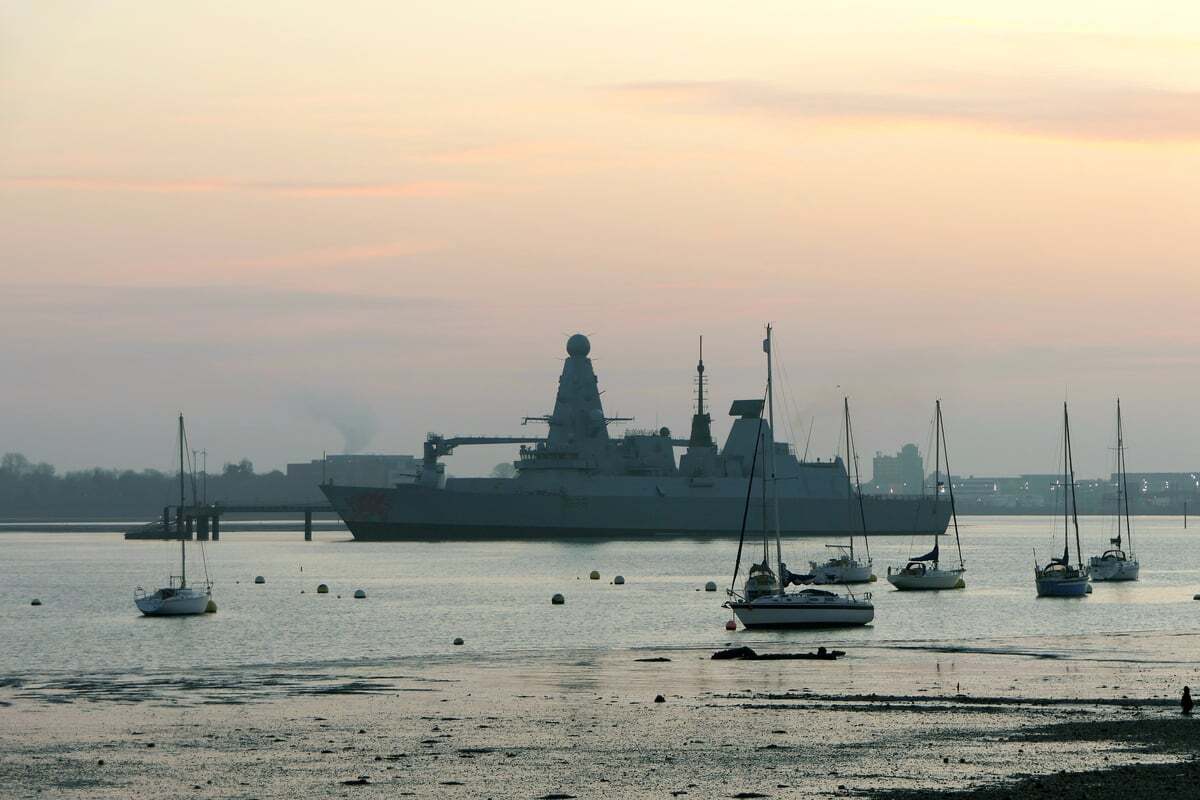
A Royal Navy destroyer that was preparing for a completely different mission has been urgently reassigned as Britain rushes to reinforce its defences in the Middle East.
The Type 45 destroyer HMS Dragon is now being prepared to deploy to the Eastern Mediterranean following a drone strike on RAF Akrotiri.
However, the warship cannot sail immediately, because it was originally configured for another operation.
Armed Forces Minister Al Carns confirmed the vessel had to be “completely re-rolled” for the new mission.
Speaking to Reports, Mr Carns said:
“That vessel was being fitted out for a different task. We’ve now completely re-rolled it. We’re going through different bits of maintenance to make sure that as fast as possible we can get that system up and running.”
Urgent Work Underway in Portsmouth
The destroyer is currently undergoing extensive work at HMNB Portsmouth, where crews are replenishing supplies and loading air-defence missiles at the Upper Harbour Ammunitioning Facility.
Engineers are also finishing welding work, conducting maintenance and altering weapon systems before the ship can safely sail.
Mr Carns said the priority is to prepare the vessel “as fast as possible”.
Reports suggest the destroyer could take several days to become operational, potentially sailing sometime next week.
Originally, HMS Dragon had been scheduled to lead NATO Standing Maritime Group 1 after completing a maintenance period.
The escalating crisis in the Middle East has now forced a dramatic change of plans.
War in the Region Intensifies
The rapid shift comes as conflict between Iran and US-Israeli forces enters its sixth day, with strikes continuing across the region.
The crisis has also left British travellers stranded.
A rescue flight operated by British Airways from Muscat, Oman, is expected to land in the UK early on Thursday (5 March).
The evacuation had been delayed after a technical issue prevented the charter aircraft from departing as planned.
Commercial flights from the United Arab Emirates remain cancelled because of airspace restrictions caused by the conflict.
Around 138,000 British nationals have registered their presence across the Middle East.
Questions Over Britain’s Military Presence
The government has also faced criticism after the drone strike on RAF Akrotiri exposed the limited number of UK naval assets currently based in the region.
In recent years the Royal Navy has shifted focus towards the High North and the North Atlantic to counter Russia’s growing maritime activity.
The last permanently stationed warship in the Middle East, HMS Lancaster, ended its deployment in December 2025.
It marked the first time since 1980 that Britain had no permanent naval presence in the area.
Fleet Commander Steve Moorhouse previously defended the decision, arguing it aligned with allied priorities, though the move attracted widespread criticism.
Reinforcements Already Deploying
Prime Minister Keir Starmer has announced additional support will be sent to Cyprus.
Royal Navy AW159 Wildcat helicopters armed with Martlet missile anti-drone systems are expected to arrive this week.
They will reinforce Eurofighter Typhoon jets, F-35B Lightning II aircraft, radar systems and counter-drone teams already deployed at RAF Akrotiri.
The Ministry of Defence said UK fighter jets are now flying continuous sorties to defend British bases and personnel from Iranian attacks.
Allies Also Moving Forces
Other European allies are also strengthening their presence in the region.
France has deployed its flagship nuclear-powered aircraft carrier Charles de Gaulle along with escorting warships and its air wing.
Meanwhile Kyriacos Kouros welcomed the planned deployment of HMS Dragon, but warned the destroyer may take more than a week to arrive.
He noted that Greek forces are already present on the island, while French reinforcements are on their way.
“The least we expect is the Britons to also be present,” he said.
A Race Against Time
For now, the Royal Navy is racing to prepare HMS Dragon for deployment.
The Ministry of Defence confirmed crews are working at pace to ensure the warship is fully armed and operational before sailing from Portsmouth.
As tensions continue to rise across the Middle East, the speed at which the destroyer can reach the region may prove critical.