

Donald Trump has been briefed by the Pentagon on a range of covert and military tools that could be used against Iran if the situation there continues to deteriorate, according to US government sources.
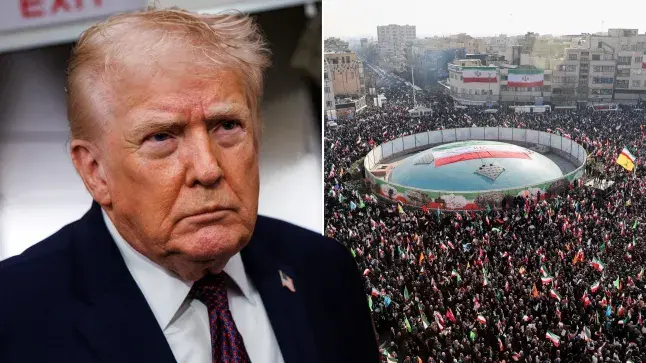
The US president is said to be weighing his options amid weeks of escalating anti-regime protests across Iran, which have been met with a sweeping crackdown involving reported killings, mass arrests and an almost total internet blackout.
Human rights observers say at least 490 protesters and 48 members of the security forces have been killed, with more than 10,000 people arrested since demonstrations spread to most major cities, including Tehran.
Cyber, psychological and military options outlined
Two Pentagon officials, speaking anonymously, said Trump had been briefed on cyber operations, psychological warfare and conventional military strikes, which could be deployed individually or in combination.
According to the officials, air strikes and long-range missile attacks are among the options under consideration, alongside cyber campaigns designed to disrupt Iran’s command structures, communications networks and state-run media.
However, defence planners have not disclosed which parts of Iran’s digital infrastructure could be targeted, or how a psychological campaign against state broadcasters might be carried out if Trump authorised action.
No final decision has been made, and Trump’s national security team is expected to hold further discussions at the White House today.
US military posture in the region
The United States maintains at least 19 military bases across the Middle East, with several located in Iraq close to the Iranian border.
While Iran is believed to have largely depleted its stock of medium-range missiles capable of travelling up to 1,240 miles, it still possesses short-range missiles with ranges of up to 435 miles, putting several US bases within reach.
Speaking aboard Air Force One on Sunday, Trump said:
“The military is looking at it, and we’re looking at some very strong options.”
Diplomacy continues, but force not ruled out
Despite the mounting tension, the US administration remains in talks with Tehran. Trump suggested, however, that diplomacy may not be enough if the crackdown intensifies.
“I think they’re tired of being beat up by the United States,” he said. “The meeting is being set up, but we may have to act because of what’s happening before the meeting. But a meeting is being set up. Iran called, they want to negotiate.”
Iranian dissidents living in exile, including crown prince Reza Pahlavi, have urged Trump to intervene after Iranian authorities threatened protesters with the death penalty.
Iran’s supreme leader Ayatollah Ali Khamenei has accused demonstrators of acting as foreign agents seeking to please the US president.
Trump responded on his Truth Social platform, writing:
“Iran is looking at FREEDOM, perhaps like never before. The USA stands ready to help!!!”
European leaders condemn violence
European leaders have also spoken out. UK Prime Minister Keir Starmer, French President Emmanuel Macron, and German Chancellor Friedrich Merz issued a joint statement over the weekend condemning the Iranian authorities’ actions.
“We are deeply concerned about reports of violence by Iranian security forces, and strongly condemn the killing of protestors,” the statement said.
“The Iranian authorities have the responsibility to protect their own population and must allow for the freedom of expression and peaceful assembly without fear of reprisal. We urge the Iranian authorities to exercise restraint, to refrain from violence, and to uphold the fundamental rights of Iran’s citizens.”
As protests continue and diplomatic efforts remain fragile, Trump now faces a critical decision over whether the US will limit its response to pressure and negotiations, or move towards direct intervention.