

What if the most dangerous weapon in Iran’s arsenal hasn’t even been used yet?
As drones buzz across Middle Eastern skies and missiles streak towards their targets, Tehran may be playing a longer, colder game, holding back its most powerful firepower until Western air defences begin to buckle. And with British personnel stationed across the region, the risk is no longer theoretical.
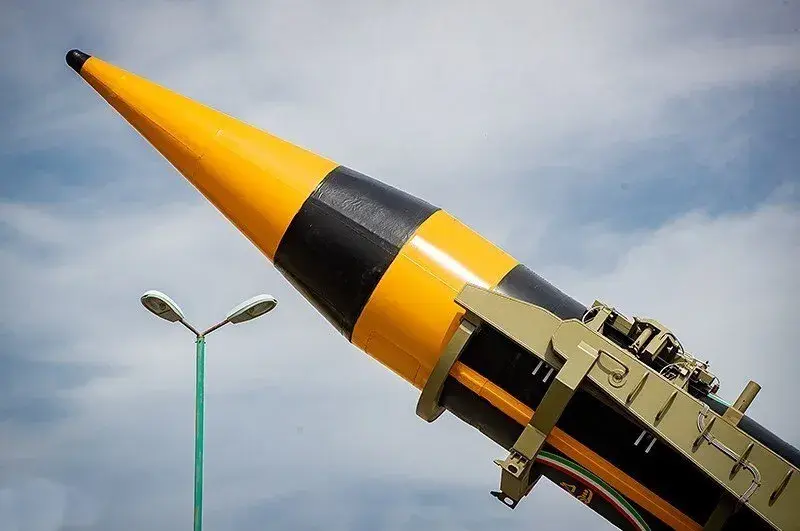
In just four days of war, Iran has launched drones and missiles at 11 countries. Yet conspicuously absent from the battlefield so far is one of its most formidable weapons: the Khorramshahr-4.
Unveiled only last month by the Iranian military ahead of the US-Israel attack, the 13-metre ballistic missile reportedly boasts a range of 2,000km (1,242 miles) and carries a staggering 1.5-tonne warhead. It is also believed to be capable of deploying cluster munitions, devastating anti-personnel weapons designed to maximise destruction.
Despite intense barrages, Israel and several Gulf states have reported high interception rates in recent days. But that success may prove temporary. Iranian media suggest the Khorramshahr-4 could soon enter the fight.
According to Professor Michael Clarke, a national security expert at King’s College London, Tehran appears to be waiting for precisely the right moment.
“Iran clearly has a strategy, which is to try to exhaust air defences and then try to overwhelm them somewhere,” he explained. For now, he believes Iran is deploying less capable weapons, before potentially unleashing its remaining heavy ballistic missiles in concentrated assaults.
“They have to try to create some holes and then use their best stuff, like the Khorramshahr, to get through carrying a big warhead,” he added.
So far, there is no evidence that the Khorramshahr-4 has been used, said Thomas Newdick, an air warfare specialist at The War Zone. He noted that some of the missiles could have been destroyed in pre-emptive strikes.
Newdick highlighted two defining features of the weapon: its extended range and the sheer size of its warhead. The addition of cluster bomb capability makes it particularly concerning.
Meanwhile, air defence stockpiles across the region are reportedly thinning. A Bloomberg report on Tuesday, citing leaked documents, claimed Qatar could run out of US-made Patriot interceptors within four days.
That matters enormously. Qatar is home to Al Udeid Air Base, the largest US military base in the region, and one also used by the RAF. Iran struck the base near the end of the 12-day war with Israel last June, though the attack was widely seen as symbolic rather than strategically decisive.
Israeli missile specialist Tal Inbar believes Iran may ultimately benefit from a numbers advantage. While Tehran is currently firing fewer missiles at Israel than during last year’s conflict, he argues that production capacity could tilt the balance.
“Missile defence is much more expensive,” he said, pointing out that interceptors such as Thaad and Arrow systems are produced at a far slower rate than offensive ballistic missiles.
On Monday, US Secretary of State Marco Rubio stated that Iran is capable of producing around 100 ballistic missiles per month, while the US can manufacture only “six or seven” interceptor missiles over the same period. Israel assessed this week that Iran possesses a stockpile of roughly 2,500 ballistic missiles.
For Israel and the US, the immediate priority is clear: destroy missile launchers before they can be used. Inbar noted that Iran has fewer launchers than missiles and would struggle to replace them if destroyed. Israel, he added, has already succeeded in eliminating many advanced missiles before launch.
Yet missiles are only part of the story.
Iran’s drones, according to Newdick, have arguably proven more effective in terms of damage and draining defensive resources. These relatively low-cost, slow-moving aircraft may not be technologically sophisticated, but they are proving tricky to counter.
“They can cause damage and destruction at a fairly low cost,” Newdick explained, “and perhaps most importantly, they can soak up air defence interceptors.”
Iranian drones have already inflicted US casualties in Bahrain, while another struck the UK’s RAF Akrotiri base.
Clarke described Akrotiri as having been “essentially undefended for years”, relying largely on stationed fighter jets for air cover. The UK Government has since moved to strengthen defences there, including deploying new radar systems and aircraft capable of intercepting drones.
Still, British troops remain exposed.
On Saturday, a missile and drone strike landed within 200 metres of British soldiers at a joint UK-US base in Bahrain. Another British unit survived a near miss in Iraq.
Although the British military has reduced its footprint in some regional bases, personnel remain stationed in Qatar, Bahrain, the UAE, Oman and Cyprus, all within range of Iranian missiles and drones.
Sharing facilities with US forces could increase the danger. Clarke warned that Tehran views inflicting losses on America as central to forcing a political shift in Washington.
“Iran only has to get lucky once or twice to make the American strategy look foolish or reckless,” he said. “They only have to hurt the Americans, not defeat them.”
And if Iran succeeds in striking a US base, British troops could find themselves victims of circumstance, collateral damage in a conflict that is escalating by the day.