

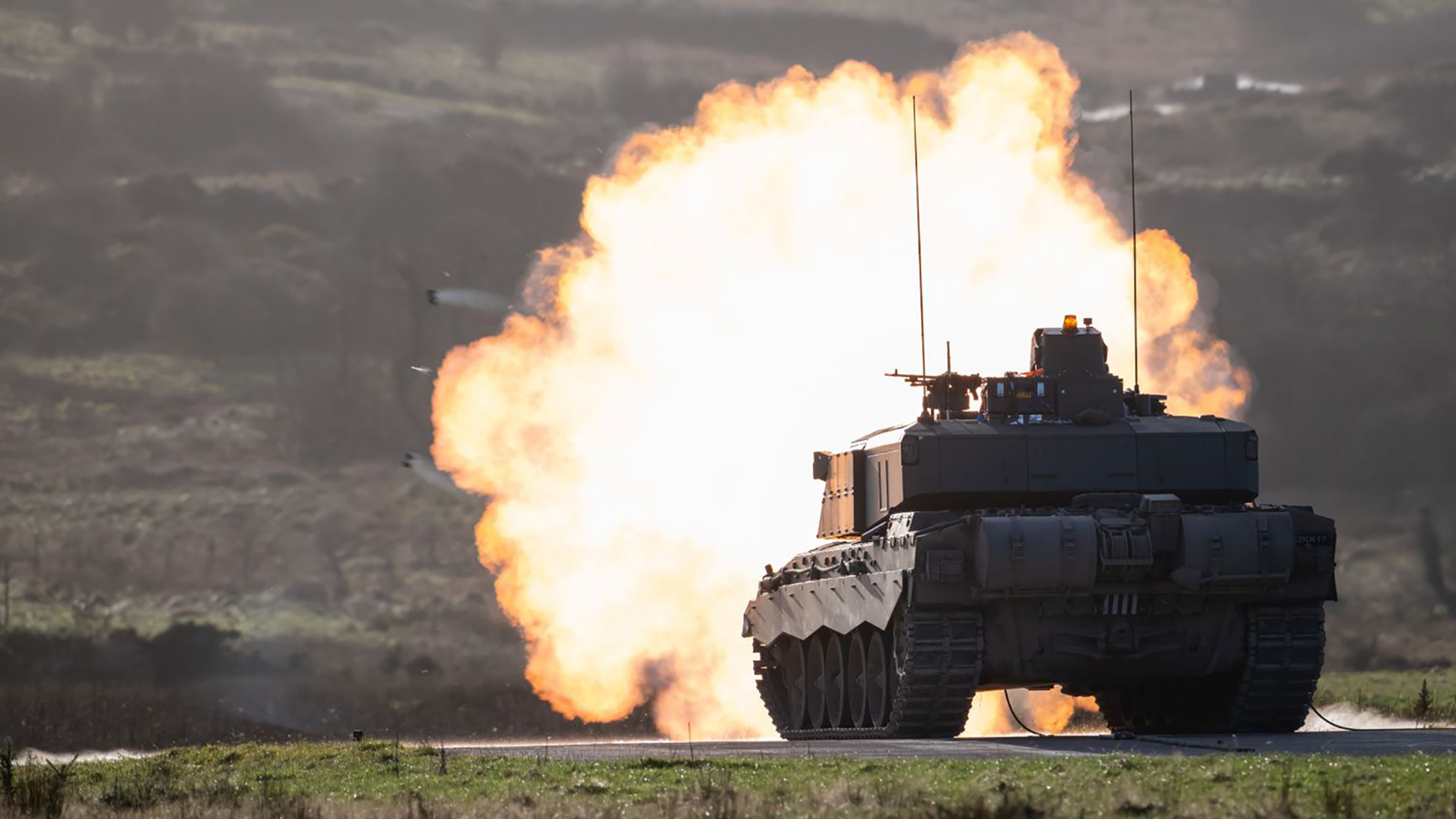
The British Army’s next-generation main battle tank has reached a key milestone after the Challenger 3 successfully fired live ammunition with a crew inside the turret for the first time.
The test marks an important step in the programme to replace the Challenger 2 and brings the new tank closer to operational service.
Previous live-fire trials of the Challenger 3 had already taken place, but these were conducted with the vehicle firing remotely. The latest firing confirmed the safety and functionality of the design with a full crew onboard.
Crewed firing trial completed
The trial was carried out by Rheinmetall BAE Systems Land (RBSL) personnel at an undisclosed Ministry of Defence training facility.
At the centre of the test was the tank’s new L55A1 120mm main gun, a UK-specific version of the Rheinmetall Rh-120 L55.
The Challenger 3’s main armament represents a significant departure from earlier British tanks.
From rifled to smoothbore
One of the defining differences between Challenger 3 and Challenger 2 is the move from a rifled to a smoothbore main gun.
The Challenger 2 was equipped with the 120mm L30A1 rifled gun, itself an evolution of the L11A5 gun used on Challenger 1. While highly accurate, the rifled design prevented the use of Nato-standard tank ammunition, which is designed for smoothbore barrels.
Until now, the British Army had been the only Nato member to field a rifled main gun on its main battle tanks.
The introduction of the smoothbore L55A1 allows Challenger 3 to fire Nato-compatible ammunition, including the latest kinetic energy anti-tank rounds and programmable multi-purpose munitions. This includes advanced APFSDS (armour-piercing, fin-stabilised, discarding sabot) rounds.
The change improves interoperability with allied forces and reduces barrel wear compared with rifled systems.
Programme progress acknowledged
Rebecca Richards, Managing Director of RBSL, said the successful crewed firing demonstrated the maturity of the Challenger 3 programme.
“Firing the vehicle first remotely and then with a crew in the turret reflects the enormous amount of work that has gone into ensuring the design is safe, robust and ready,” she said.
“This marks a proud moment for UK armoured vehicle development.”
Challenger 3 will now enter further trials as it progresses towards frontline service as part of the British Army’s wider modernisation effort.
Production and delivery
The vehicles are being designed and manufactured at RBSL’s facility in Telford, Shropshire.
A total of 148 Challenger 3 tanks will be delivered to the British Army, converted from existing Challenger 2 hulls under a contract valued at more than £800 million.
Wider upgrades beyond firepower
Although Challenger 3 is a modernised version of Challenger 2, it features an all-new turret, enhanced armour and a range of advanced electronic systems.
RBSL has highlighted major improvements to the tank’s sighting and targeting systems, including advanced thermal imagers for both commander and gunner, automatic target tracking and wide-area search capability. Driver sighting systems have also been upgraded.
The company says these enhancements significantly improve situational awareness and reduce the time required to identify and engage targets.
New electronic threat detection systems provide earlier warning of enemy fire, improving crew survivability.
Addressing past criticism
Ukrainian crews operating Challenger 2 tanks praised the platform’s protection and firepower but criticised its engine as underpowered.
Challenger 3 addresses these concerns with an upgraded engine, improved cooling and an enhanced hydrogas suspension system, aimed at improving mobility and reliability.
Entry into service timeline
Challenger 3 is expected to achieve Initial Operating Capability in 2027, with all 148 vehicles planned to be fully in service by the end of 2030.