


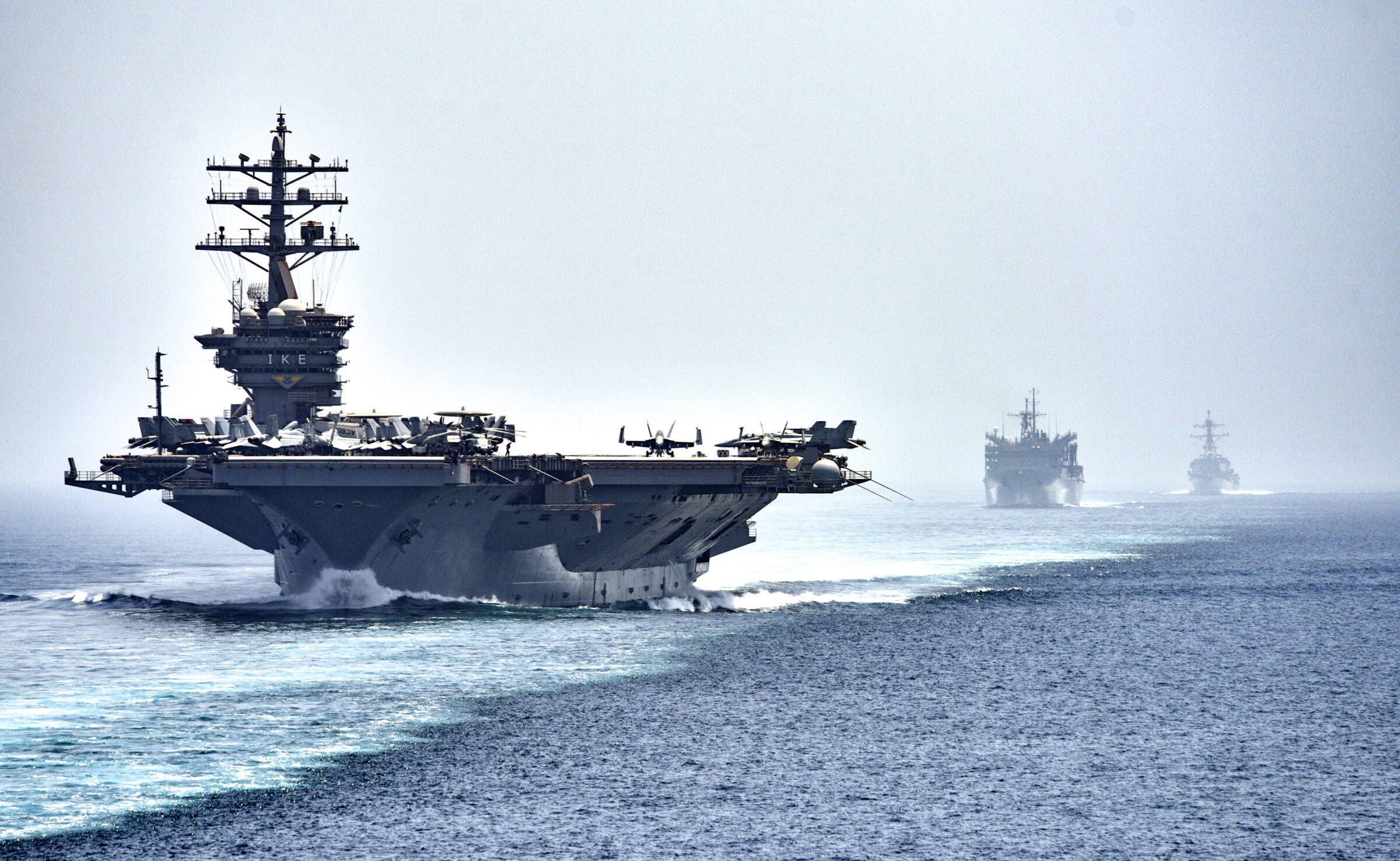
The United States Navy remains outside the Strait of Hormuz as Iran strengthens its ability to control one of the world’s most critical shipping routes, highlighting a major shift in modern naval warfare.
Despite its unmatched size and firepower, the US Navy has not attempted to force its way into the narrow waterway. Instead, American aircraft carriers are operating well beyond the Persian Gulf, out of range of Iranian missile systems.
The situation raises a pressing question: why is the world’s most powerful navy unable to act?
Missile threat reshapes the battlefield
The answer lies in Iran’s long-developed network of anti-ship missiles.
Since the late 1990s, Iran has built up defences along its southern coastline and on key islands, including Abu Musa and the Tunbs. These missile systems, housed in reinforced bunkers, are capable of targeting ships passing through the strait with minimal warning.
This has effectively turned the narrow passage into a high-risk zone for large naval vessels.
A shift from dominance to deterrence
For much of the 20th century, US naval power operated with near-total freedom.
During the Second World War, American fleets played a decisive role in both the Pacific and Atlantic theatres, shaping the global balance of power. Aircraft carriers became central to that dominance, offering the ability to strike targets far inland from the sea.
That strategy continued through later conflicts. During the Vietnam War, US carriers operated around 90 miles offshore at “Yankee Station”, launching sustained air operations despite heavy losses.
Even after the Cold War, US warships moved freely through the Persian Gulf, enforcing no-fly zones over Iraq and supporting United Nations sanctions.
Today, that freedom no longer exists.
The rise of anti-access warfare
Iran’s strategy reflects a broader military approach known as anti-access or area denial. Rather than competing directly with US naval strength, it relies on relatively low-cost systems to deter and restrict movement.
China has adopted similar tactics, developing long-range anti-ship missiles such as the DF “Dong Feng” series, capable of striking moving vessels at significant distances. Military simulations suggest US forces could face serious losses in such environments.
Multiple threats in a confined space
Any attempt to enter the Strait of Hormuz would expose US vessels to a range of dangers.
These include naval mines—an issue the US Navy has faced since the 1980s, as well as unmanned systems operating both above and below the water. The narrow geography of the strait reduces reaction times, increasing the vulnerability of even the most advanced ships.
Lessons from recent conflicts
Recent events in the Black Sea have demonstrated how modern warfare is evolving. Ukraine has successfully used missiles and unmanned systems to push back Russian naval forces from its coastline.
Iran has incorporated similar capabilities into its own strategy, increasing the risks for any navy operating nearby.
No easy military solution
Suggestions that the US could reopen the strait by force face significant challenges.
Iran’s geography allows it to launch attacks from well inland, making it difficult to eliminate the threat through limited military action. At the same time, the high cost and limited replaceability of US naval vessels make any confrontation a serious strategic risk.
A changing balance at sea
The situation in the Strait of Hormuz reflects a wider shift in global military power.
The era of aircraft carriers operating close to hostile coastlines with relative impunity is fading. In its place is a more contested environment, where cheaper and more precise weapons can hold even the most powerful navies at a distance.
For now, the US Navy remains on the edge of the strait, adapting to a battlefield that no longer guarantees its dominance.