

After weeks of tension and escalation in the Middle East, an unexpected twist from Donald Trump may have handed Britain a rare diplomatic opportunity.
The US president has publicly called on allies, including the United Kingdom, France, Japan, South Korea, and even China, to help secure the vital shipping lane through the Strait of Hormuz.
Posting on social media, Trump extended the invitation to “all the countries of the world that receive oil through the Hormuz Strait”. In theory, that could include almost any nation dependent on global energy supplies, an extraordinary appeal that underlines how serious the situation has become.
Yet the request also raises an uncomfortable question: if the United States now needs help, how should Britain respond?
A Complicated but Essential Alliance
Despite the political friction that has occasionally surfaced between the two leaders, the relationship between the United Kingdom and the United States remains strategically vital.
Britain depends heavily on American cooperation for intelligence sharing, advanced weapons systems and support for its nuclear deterrent. The security framework of NATO, which still underpins European defence, also relies overwhelmingly on US power.
That reality means any request for British assistance is unlikely to be ignored, even if it does not automatically translate into direct involvement.
At the same time, many policymakers in London believe it is not in Britain’s interest for Iran to develop nuclear weapons, another factor shaping the government’s calculations.
Starmer’s Delicate Balancing Act
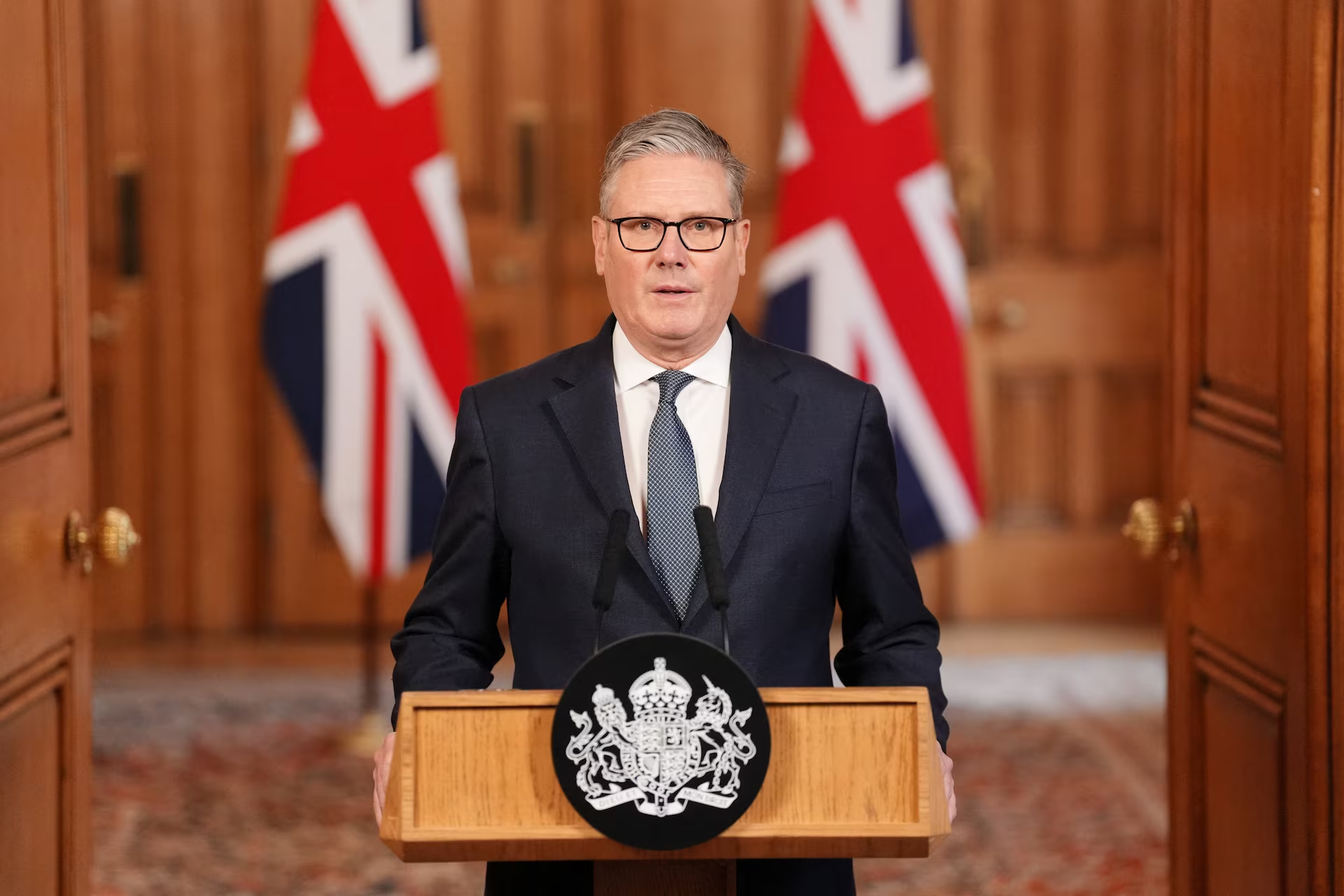
For Keir Starmer, the decision is far from straightforward.
The prime minister has so far taken a cautious approach to the conflict, focusing on diplomacy and restraint rather than immediate military escalation. But protecting global shipping routes, particularly through the Strait of Hormuz, a critical artery for the world’s oil supply, is widely seen as a legitimate defensive priority.
Safeguarding that route matters not just for international trade but also for British living standards, as disruption could have major consequences for energy prices and the wider economy.
A limited deployment of defensive technology, such as mine-clearing drones, would align with Starmer’s policy of supporting stability without becoming directly involved in offensive military operations.
The distinction may sound technical, but it carries significant legal and political weight. There is a profound difference between clearing mines that threaten civilian shipping and taking part in bombing campaigns against cities.
A War Without a Clear Plan
Critics of the conflict argue that the war against Iran, often referred to as Operation Epic Fury, has unfolded without a coherent long-term strategy.
Some observers also note that the United States has not yet committed its own navy to operate extensively in the most dangerous parts of the Persian Gulf, where mines and drone attacks pose serious risks.
For Britain, entering such a volatile environment requires careful judgement. Any involvement must avoid drawing the country deeper into a conflict that could spiral far beyond its original scope.
The Case for Diplomacy
From the outset, Keir Starmer has pushed for a negotiated settlement to the crisis, a stance that is increasingly gaining support as the conflict spreads across the region.
Recent strikes and retaliatory attacks have affected multiple cities, including Beirut, Riyadh, and Dubai, illustrating how quickly the situation could widen.
History offers a clear warning: bombing campaigns rarely achieve regime change on their own. In many cases, they strengthen the resolve of the population under attack rather than weakening it.
A Missed Opportunity for Peace?
According to Donald Trump, Iran has already proposed a potential peace deal, though he has dismissed it as insufficient.
Yet some diplomatic sources suggest negotiations had previously been close to success. Talks mediated by Oman reportedly came close to producing an agreement under which Iran would stop stockpiling enriched uranium, effectively ending its nuclear weapons ambitions.
Those talks collapsed shortly before the conflict escalated, a development widely attributed to pressure from Benjamin Netanyahu, who urged Washington to take a more aggressive stance.
If those reports are accurate, the strategic objective of the war may already have been achieved before the first missiles were fired, raising difficult questions about why the conflict began in the first place.
A Rare Moment of Leverage
For Britain and other mid-sized powers, the current situation presents an unusual opportunity.
By offering limited support in securing the Strait of Hormuz, countries such as the UK, France, and Japan could gain greater influence over Washington’s strategy.
In return for assistance, they could push the White House to de-escalate the conflict before it expands into something far more dangerous.
Because if the war continues to spiral, drawing in more countries and threatening global energy supplies, the consequences will stretch far beyond the Middle East.
And for Keir Starmer, that means walking a careful line: supporting allies, protecting British interests, and using diplomacy wherever possible to prevent the conflict from becoming something far worse.