

What unfolded overnight wasn’t just another exchange of fire. It was a sharp escalation across multiple fronts, with the United States, Iran, and Israel all striking within hours of each other, and the consequences are already rippling far beyond the region.
The United States confirmed it launched powerful strikes on Iranian missile sites positioned along the Strait of Hormuz, using 5,000-pound bunker-busting bombs designed to penetrate hardened underground facilities. According to US Central Command, the operation “successfully employed multiple deep penetrator munitions” to degrade Iran’s ability to shut down one of the world’s most critical oil routes.
That matters. Because the Strait of Hormuz isn’t just another chokepoint, it’s a lifeline for global energy. And any threat to it sends shockwaves through markets instantly.
At the same time, tensions inside Iran escalated. A projectile struck the Bushehr nuclear power plant complex, though the International Atomic Energy Agency confirmed there were no injuries and no damage to the facility.
Despite the growing instability, oil markets are already reacting. Brent crude remains above $100 per barrel, more than 40% higher than when the conflict began, reflecting just how fragile the situation has become.
Since the outbreak of war, triggered by US and Israeli strikes on Iran, Tehran has shifted strategy. Rather than closing the Strait entirely, Iran has targeted energy infrastructure across Gulf Arab states and military bases, aiming to drive up oil prices and apply pressure on Washington.
Iran insists it is only targeting vessels linked to the US or Israel, claiming that over 90 ships, including oil tankers, have been allowed safe passage. Meanwhile, the country continues exporting oil, benefiting directly from rising global prices, with much of that supply flowing to China.
But the most significant escalation came in response to the killing of Ali Larijani, one of Iran’s most powerful political figures and a key architect behind its national security strategy.
In retaliation, Iran’s Revolutionary Guard launched multiple-warhead missiles towards central Israel. These weapons are specifically designed to evade missile defence systems and overwhelm radar tracking.
Israel reported at least two waves of incoming fire. In Ramat Gan, just east of Tel Aviv, two people were killed. The missiles used, including the Khorramshahr-4 and Qadr systems, signal a clear shift towards more complex and harder-to-intercept attacks.
Larijani was no ordinary figure. A former parliamentary speaker and senior adviser during nuclear negotiations with the Trump administration, he was deeply embedded in Iran’s strategic decision-making. He was also widely believed to have played a role in suppressing internal protests.
Meanwhile, Israel has expanded its operations into Lebanon.
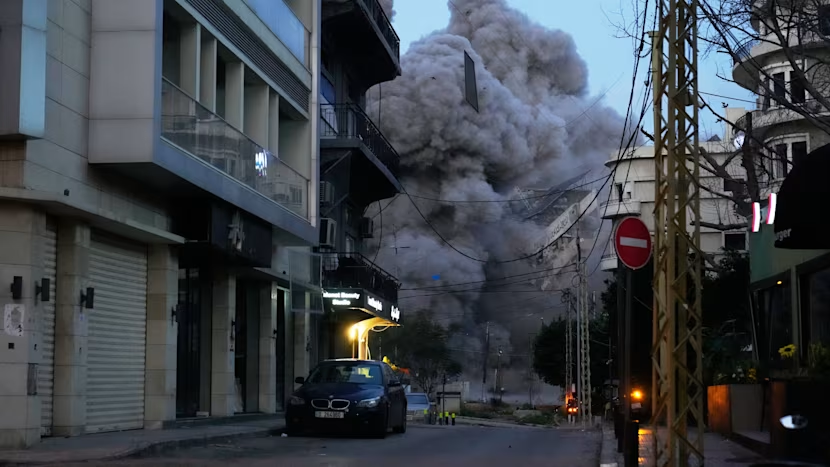
In Beirut, an apartment building was completely flattened shortly after an evacuation warning was issued. It marked the fourth attempt to destroy the structure, after earlier strikes failed. Israel claims the building was being used by Hezbollah to store millions of dollars to fund its operations, though no evidence has been publicly provided.
There were no immediate reports of casualties from that specific strike. However, broader attacks in central Beirut have already killed at least six people and injured 24, according to Lebanon’s Health Ministry.
Israeli forces have also launched a new wave of strikes in southern Lebanon, citing cross-border fire from Hezbollah as justification.
The humanitarian impact is escalating rapidly. More than one million people in Lebanon, roughly a fifth of the population, have been displaced. Over 900 have been killed.
Inside Israel, Iranian missile attacks have killed 14 people. The United States has confirmed the deaths of at least 13 military personnel.
And in Iran, the toll continues to climb. The Iranian Red Crescent reports more than 1,300 people have been killed since the conflict began.
This is no longer a contained regional conflict. It is a multi-front confrontation with global economic consequences, rising civilian casualties, and increasingly advanced weapon systems entering the fight.
The question now isn’t whether this escalates further.
It’s how far it goes, and who gets pulled in next.