

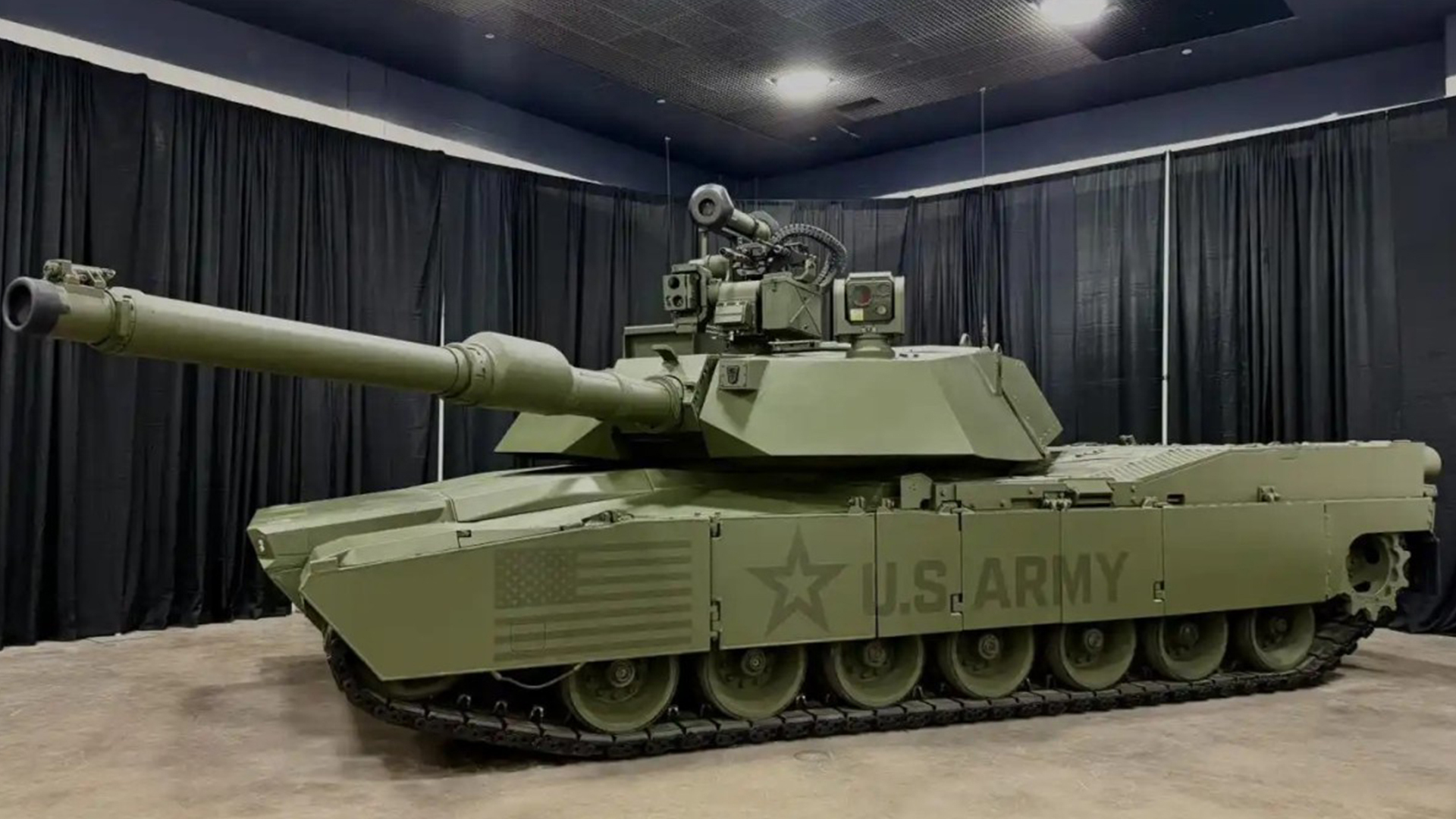
The US Army has unveiled an early prototype of its next-generation main battle tank, the M1E3 Abrams, offering a glimpse of a lighter, more digitally driven vehicle designed for future warfare.
The prototype was revealed at the Detroit Auto Show, where the US Army’s Chief of Staff, General Randy George, drew comparisons between the new tank and high-performance cars. While joking that it was not “as fast as a Corvette”, he said it could “take out a target at a quarter mile in a tenth of a second”.
Speaking at a subsequent event, General George continued the automotive theme, describing the driver’s compartment as resembling the cockpit of a Formula 1 car. He also said the way the tank is driven “looks like an Xbox controller”.
Hybrid power and artificial intelligence
The M1E3 Abrams will be powered by a hybrid-electric drivetrain and will incorporate a range of AI-enabled digital engineering tools, including generative AI. These systems are intended to allow faster integration of new technologies and support an open systems architecture.
Michelle Link, one of the senior officials overseeing the programme, said the tank would combine advanced protection with reduced weight, while cutting logistical demands.
The new Abrams is being designed to counter a broad range of modern threats, including drones and long-range precision weapons, which have become increasingly prominent in recent conflicts.
“This next-generation Abrams is designed to transform how armoured units operate globally,” Ms Link said.
“By streamlining its sustainment needs and increasing deployment speed, the M1E3 Abrams ensures faster movement from ports to the frontlines, making it more agile and accessible in any environment.”
A shift in design priorities
While main battle tanks have traditionally balanced firepower, protection and mobility, the US Army is now placing additional emphasis on software, mobility and lethality, reflecting the growing importance of digital systems on the battlefield.
The Army said the M1E3 would incorporate the best features of the M1A2 SEPv4 while complying with the latest modular open systems architecture standards. Officials described it as more survivable, lighter and easier to upgrade than earlier Abrams variants.
Production of the M1A2 SEPv3 will continue at a reduced rate until the transition to the M1E3 begins. New technologies developed for the M1E3 are also expected to feed into future Abrams modernisation efforts.
Why ‘E’ and not ‘A’?
The designation of the new tank has also drawn attention. Speaking in 2023, Major General Glenn Dean, another senior official on the project, said the war in Ukraine had underscored the need for improved crew protection in armoured vehicles.
He explained that the ‘E’ designation reflects a significant engineering change rather than a minor upgrade.
“The M1E3 Abrams nomenclature is a return to the Army’s standard use of its type classification and nomenclature system for our combat vehicle fleet,” he said.
“The ‘E’ designation represents an engineering change to an existing platform that is more significant than a minor modification.
“It serves to designate the prototype and development configuration until the vehicle is formally type-classified and receives an ‘A’ designation.”
Looking ahead
The US Army expects the M1E3 Abrams to reach initial operational capability in the early 2030s, marking the next major evolution of the Abrams platform as it adapts to increasingly complex and technology-driven battlefields.